
Facebook & Instagram
Connecting content creators to their fans with channels
Launched a 0-to-1 messaging primitive used by half a billion people
As posts, reels, and stories became more polished and higher effort to make, messaging emerged as the most popular way to share. People crave lowkey, authentic ways to express themselves and connect. As a result, we created broadcast channels, a one-to-many chat for creators to send quick updates to anyone who joined. I was the founding content designer on the Facebook Messenger side and later the content lead on Instagram channels.
Launching a new product in a well-established space takes grit and iteration. I defined the new primitive, shaped brand positioning with marketing, and mitigated risks with legal. I later drove a team of 4 to simplify our public messaging ecosystem, ultimately renaming “broadcast channel” to “channel.”
-
Facebook
Introducing Broadcast Channels on Facebook and Messenger -Meta Newsroom
Meta to roll out broadcast channels to Facebook, Messenger -Reuters
Meta is bringing its Telegram-like broadcast channels to Facebook and Messenger -TechCrunch
Connect more deeply with your audience using broadcast channels -Facebook creators blog
Instagram
Introducing broadcast channels: A new way for creators to deepen connection with followers -Meta Newsroom
Instagram is rolling out its Channels feature for broadcasting messages globally -TechCrunch
Instagram creators can now turn on replies in broadcast channels -The Verge
Open a direct line to your closest audience -Instagram creators blog
New channels features -@creators on Instagram
Taming inbox chaos
Helped millions of content creators organize their messages
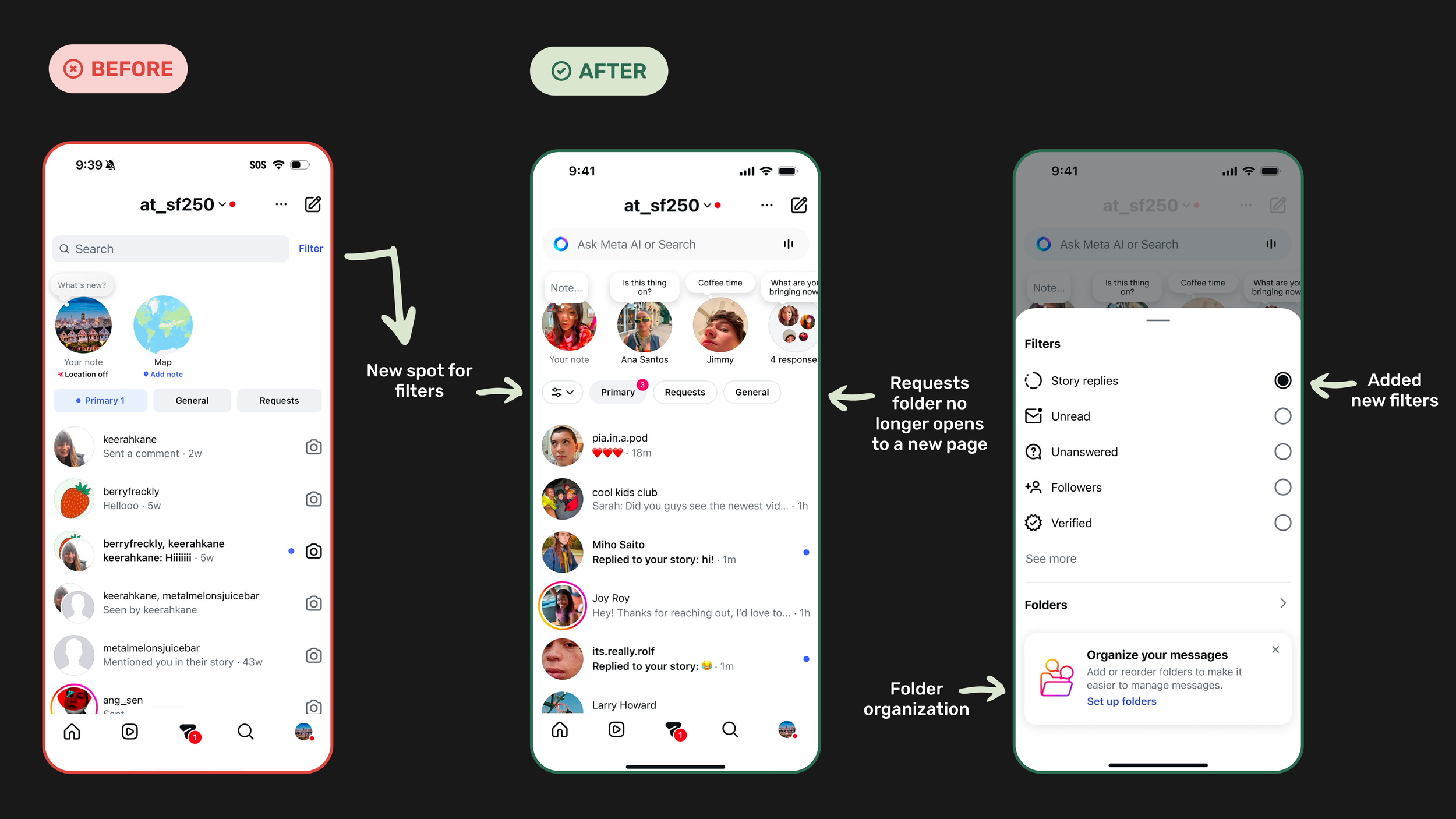
Large content creators get hundreds of DMs a day, and the messages that matter most can get lost in the noise. I refined confusing UI terminology and helped to redesign the inbox’s information architecture by surfacing message requests at the top layer, improving filter access, and adding folder management and sorting so high-value conversations stay visible. I also explored AI-powered message organization solutions, including iterating on system prompts and evaluating internal and external LLMs.
Simplifying stories so they’re easier to create
Shipped craft improvements and built features to spark people’s creativity
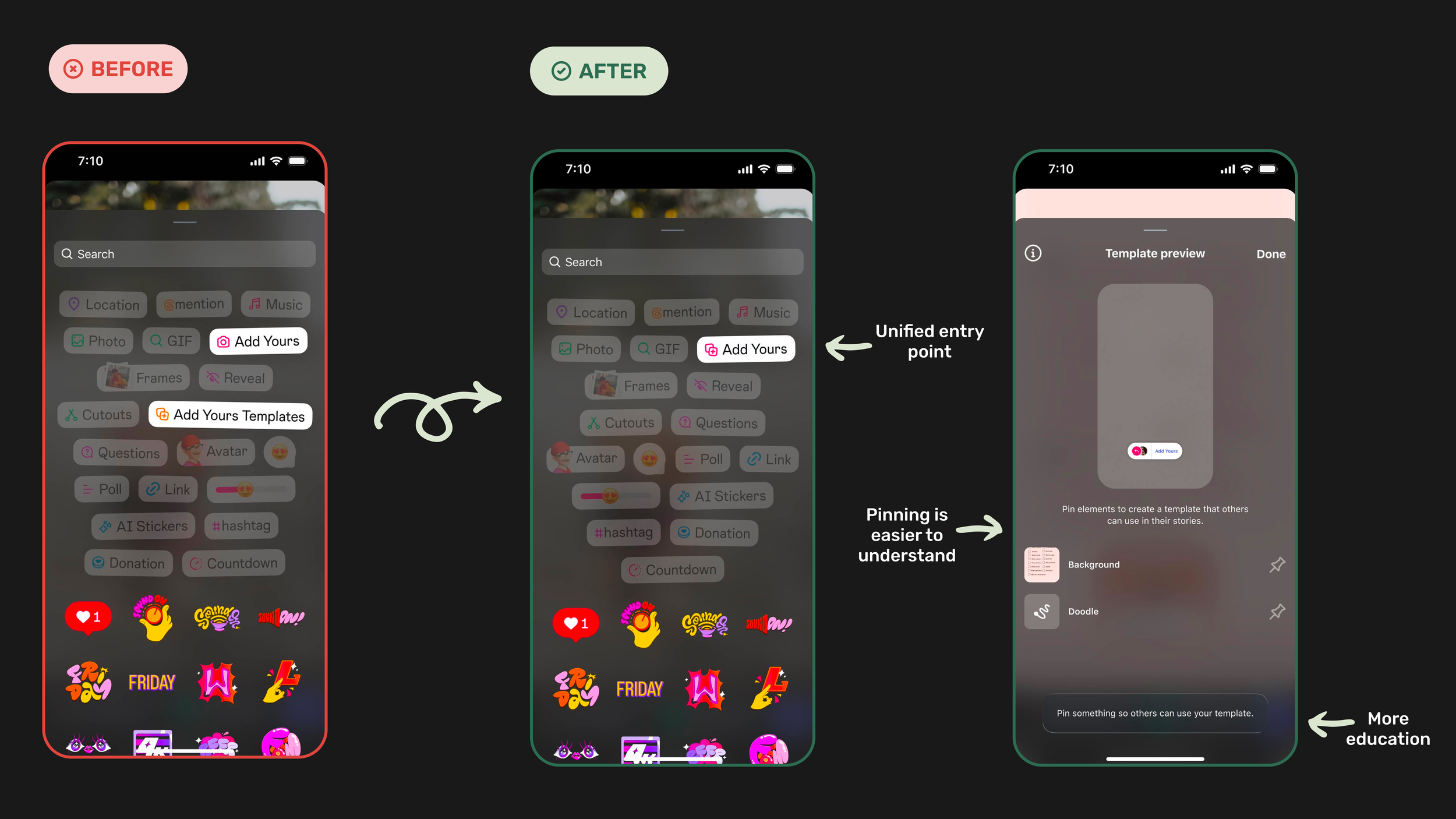
People are posting less, citing a lack of inspiration and discomfort sharing personal content. Instead of prompting stories from scratch, my team bet on giving people tools to pique their curiosity while they viewed them. I developed timely upsells, like trending music, to spark story creation and categorized story elements to view and save parts of someone else’s story. I also simplified language around “Add Yours” story templates, unifying 2 entry points for the same feature into one path, showing a 2% bump in creation.
Scaling conversations in the comments
Got more people talking about creators’ content
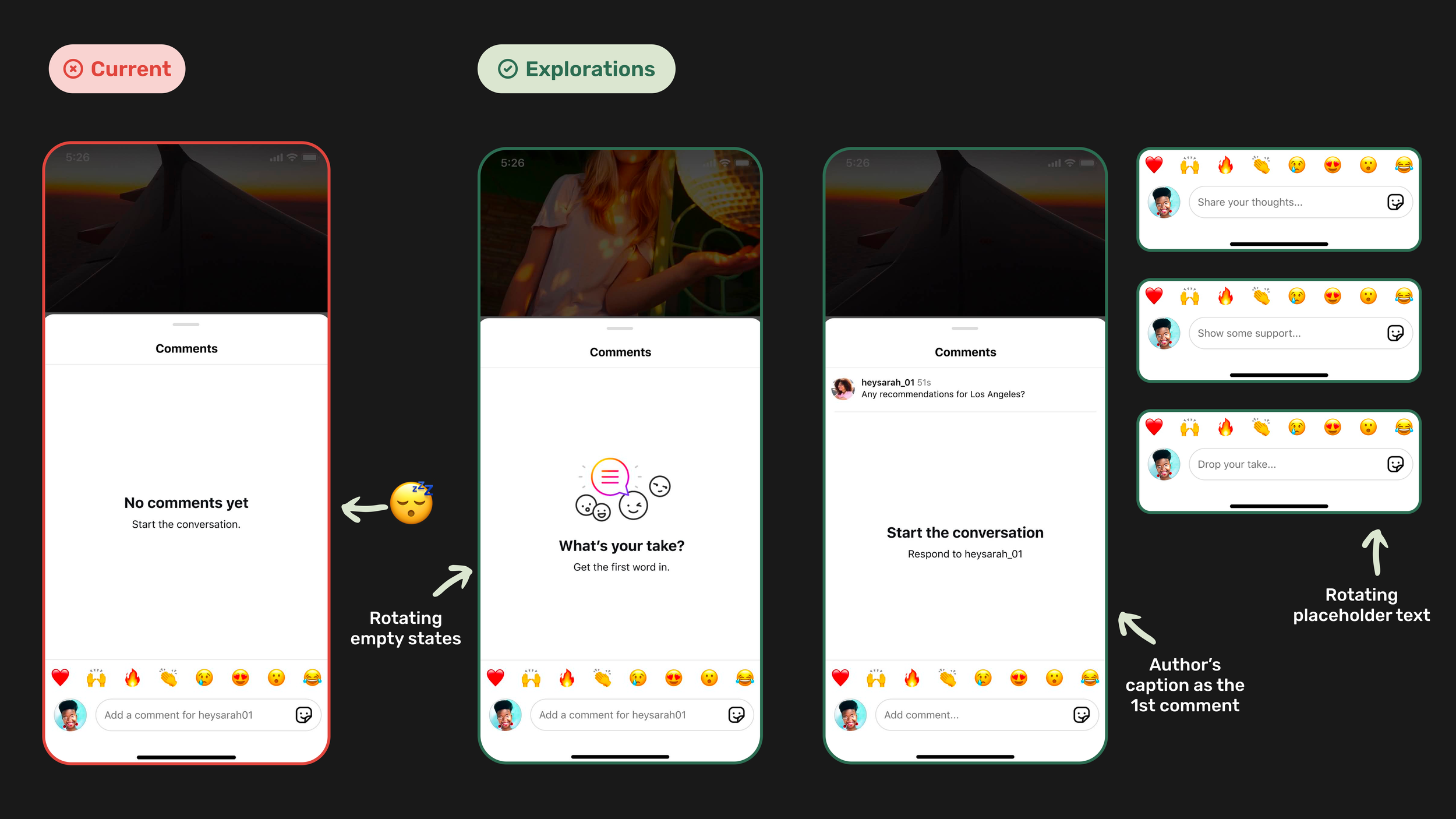
Comments are an easy way for creators to build community, but sometimes words just aren’t enough. I led content design for adding photos to comments, improving the feedback loop between creators and their audience. I also partnered with product design to explore lightweight AI-assisted replies that preserve a creator’s voice. I experimented with new placeholder text across the composer and empty states to nudge users to interact on a post.
Messenger Kids
Making the app easier to read with one word
Reshaped terminology to match appropriate reading levels
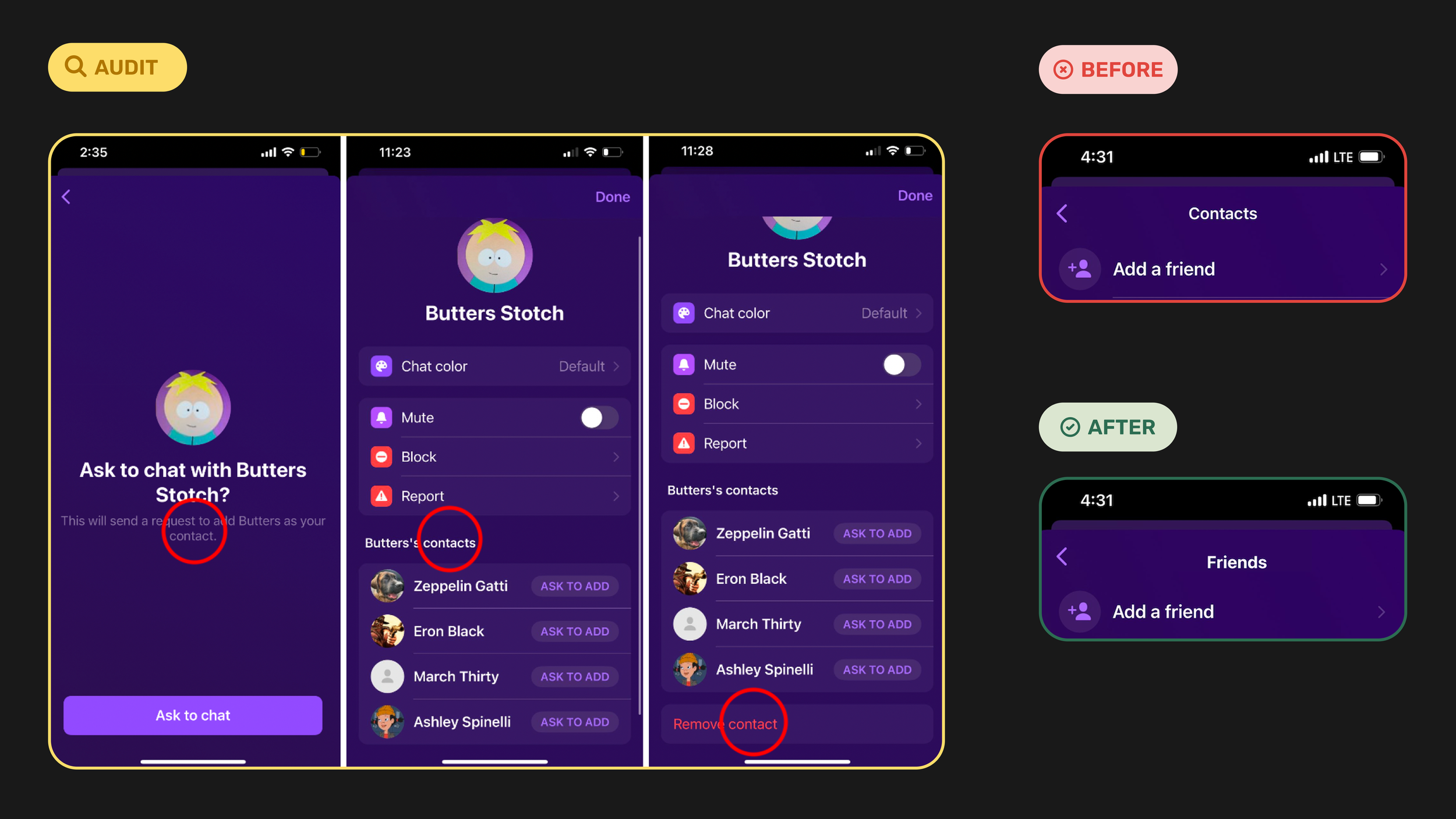
Messenger Kids is a chat app for children (ages 6-10) where parents approve and monitor who they can message. When I first joined, I audited core flows and found “contact” and “friend” used interchangeably throughout the UX, muddying our voice and comprehension for young readers.
I aligned stakeholders to use “friend” app-wide, making the product warmer and easier for kids to understand. I updated 1,900+ instances of the term without engineering support, executing the change end to end myself.
Meta Integrity

Modernizing content review at scale
Centralized tooling systems to keep our communities safe online
Moderating content for the world’s largest platforms is no easy feat. To meet user needs and government regulations, Meta needed to build the right tooling to tackle major social issues online. I modernized the review tool’s homepage by surfacing the most important information at the top and rearchitecting the left navigation so content reviewers could scan policies faster. I also developed templates for communication channels to help reviewers and operation teams stay agile amid constant policy changes.
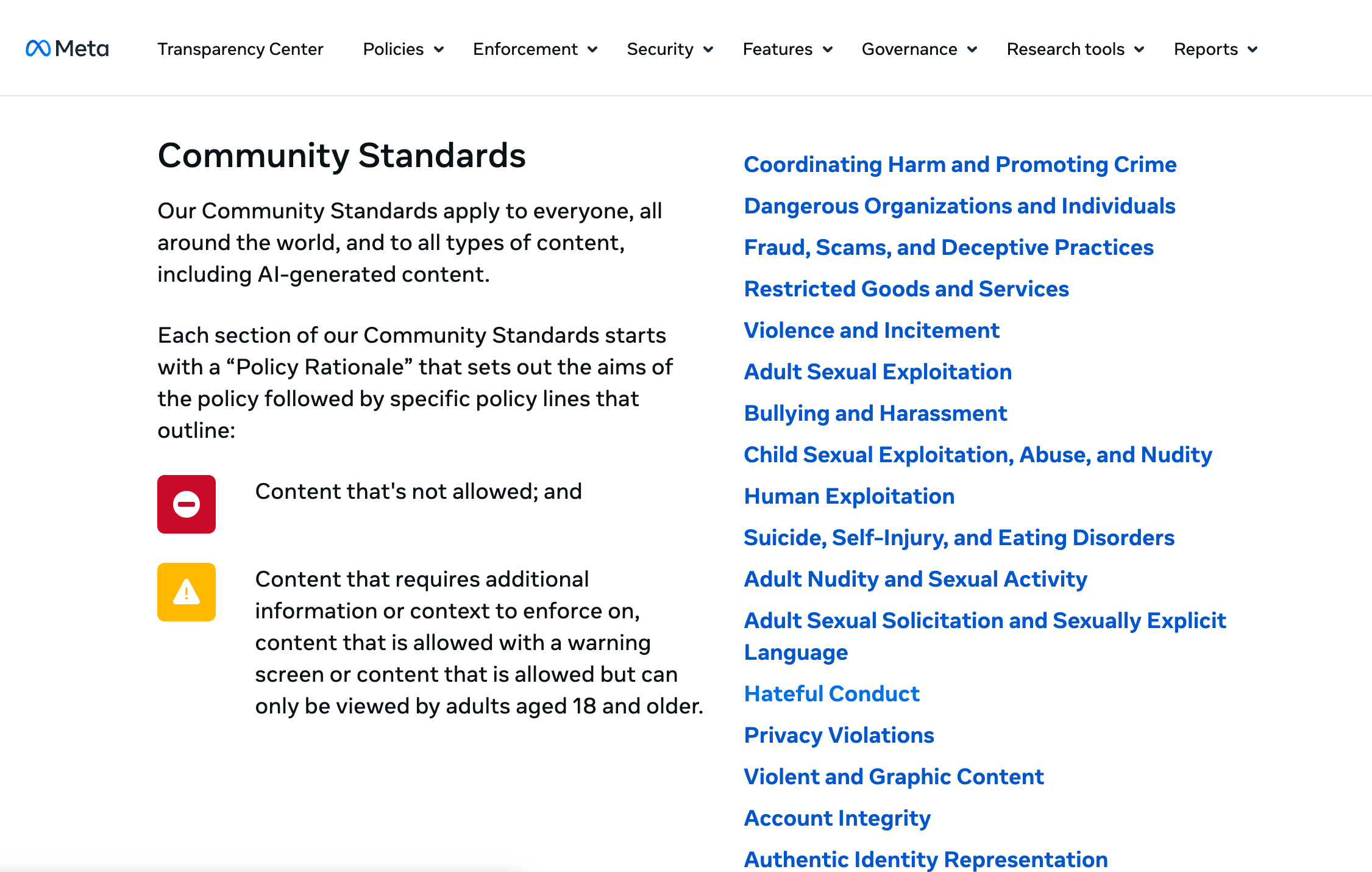
Improving policy comprehension for content reviewers and AI
Reduced length of policies to make them easier to read
Reviewers are responsible for learning 20+ Community Standards to moderate content across Meta platforms. These policies are written by policy and legal teams for an audience that’s often non-technical, making it challenging to interpret the policies quickly. I took the initiative to audit our internal policies to see how we could cut redundancy in information. My redesign featured a table structure to make policy language more scannable and shorter (by 30%!) for both reviewers and AI to read.

Supporting content reviewers’ well-being
Designed tooling to protect our reviewer community
Meta’s content reviewers play a vital role in keeping communities safe online, often reviewing graphic and objectionable content regularly to remove it from the platform. Specifically, I designed education around daily breaks, impact summaries to recognize their contributions, custom filters to cover graphic content, and access to coaches for more support. My team and I developed a framework to measure the impact of the tools we built when we had no metrics to guide us.
-
Our Commitment to Our Content Reviewers -Meta Newsroom
An Update on Compensating and Supporting Facebook’s Contractors-Meta Newsroom
Facebook is expanding its tools to make content moderation less toxic -Fast Company
What I learned
-
Designed the words people see, hear, and interact with across dozens of products and features and illustrated solutions in Figma
-
Vibecoded changes to production, prototyped in Cursor, developed system prompts to build AI-powered products, and conducted model evaluations to ensure accuracy
-
Shaped stories and value propositions backed by research to get designs approved and products shipped
-
Categorized hierarchies of information to make the UI easier to understand for people
-
Led several efforts and developed processes to reduce confusion around product names and terms across apps
-
Adapted language to meet voice guidelines and matched tones for appropriate situations
-
Implemented content standards org-wide to minimize overhead and adhered to design system standards to promote consistency across products
-
Taught myself how to make string edits in Phabricator, served oncall for an internal string management tool, and vibecoded string changes across iOS and Android
-
Conducted A/B testing for content experiments, organized design materials for research, and participated in hundreds of user sessions
-
Approached projects with a global perspective and designed for different languages and cognitive abilities
-
Worked consistently with product design, user research, product management, engineering, data science, legal, and marketing across multiple teams and orgs